You can understand the business reasons for a change and still find it deeply unsettling when it happens to you.
This week, I've seen posts from people at HSBC facing compulsory redundancy. I've written before about my own departure five years ago, and about how easily “my role is no longer needed” can become “I'm no longer valued”.
HSBC had taken me from London to Dubai to Bangalore. I'd led large teams, built a career I was proud of and invested an enormous amount of myself in the work. I took a redundancy package during the pandemic rather than remain in India. There was a choice involved in my departure, which is different from having that decision made for you. Even so, leaving meant stepping away from a familiar world without a complete picture of what would come next.
My journey afterwards included another banking role, consulting and eventually building my coaching business. It took time. There were disappointments, and possibilities I couldn't have seen from inside the life I already knew.
But I've also been thinking about the people still inside an organisation that's going through change. Particularly the leaders expected to help everyone else through it while working out what it means for them.
Leading your team through a restructure when you're worried about your own job
You may be losing colleagues you trust, worrying about your own future or trying to understand a decision you weren't involved in. Meanwhile, your team needs reassurance, the work needs to be delivered and someone wants you to present “the plan” with enthusiasm on Thursday. You become the face of a change you don't necessarily want or agree with.
I know from my own leadership experience how much that can ask of a person. We often assume that above a certain level, people will get on board because that's what they're paid to do. We give them the messages and expect them to override the uncertainty and lead with confidence.
But where do they take their own questions? Where can they admit they disagree, feel frightened or don't yet know how to make it work?
What leaders told me about leading through uncertainty
In the leadership interviews I carried out across multiple sectors, including financial services, retail, engineering, the public sector and professional services, several themes kept coming through. Leaders described the cumulative toll of prolonged uncertainty, the loneliness of leading change and the gap between what they felt able to show and what they were actually experiencing.
There was also a thread around trusting their own judgement: being capable and experienced, yet still second-guessing whether to speak up. And around identity, with organisational changes prompting people to question who they were beyond their job title.
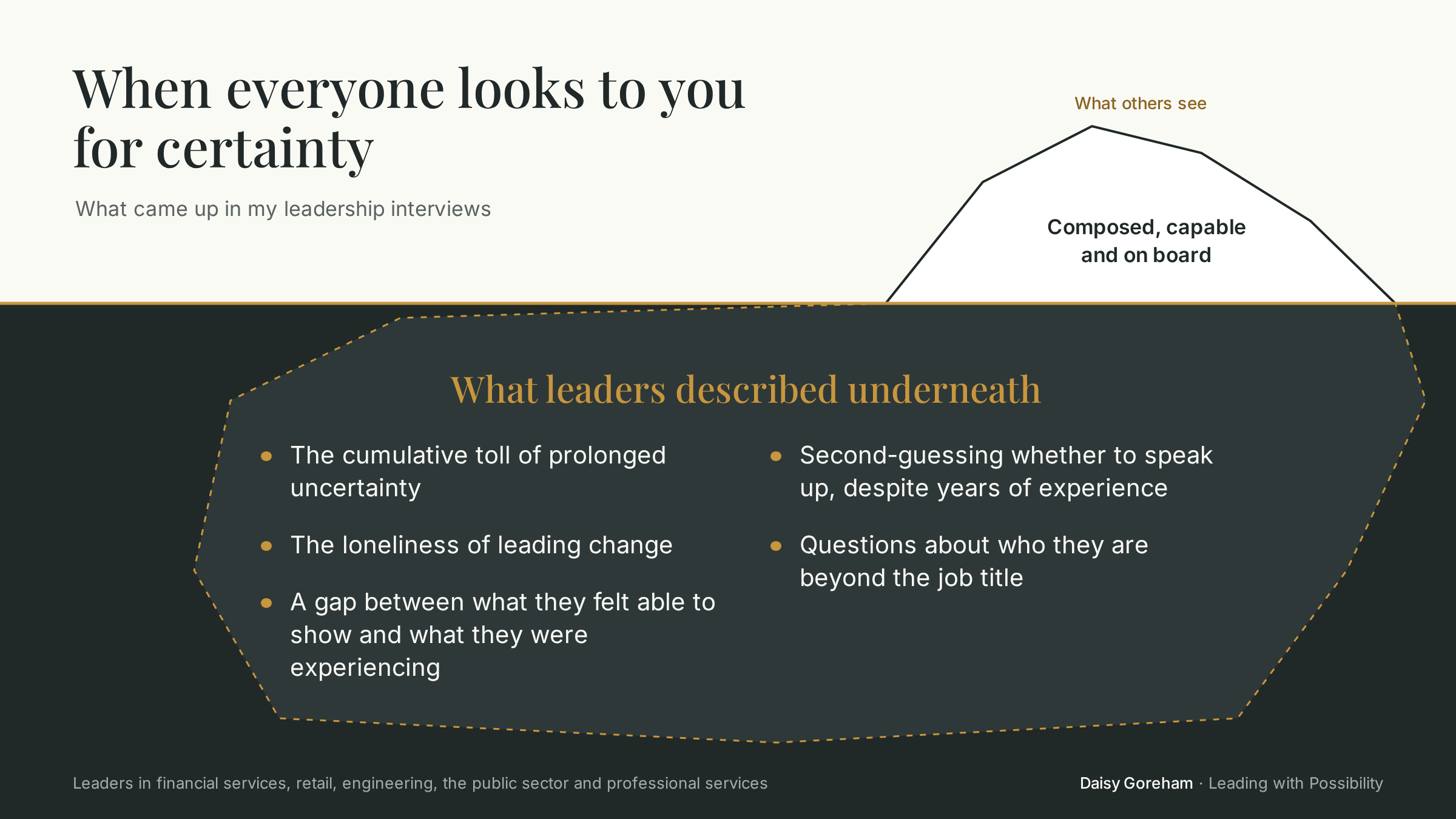
These were qualitative conversations rather than a representative survey. What stayed with me was how much could be happening underneath an apparently capable, composed exterior.
Why “are you on board?” is the wrong question to ask your leadership team
If a leader has no useful place to work through their reservations, where do they go? You may get agreement in meetings, followed by hesitation, delayed decisions or inconsistent messages to the team.
Somebody might understand the direction but lack the authority to deliver it. They might see a risk nobody has addressed. Or they may be worried that admitting they need help will undermine the confidence others have in them. This is particularly true when it feels like roles are at risk.
That's why “Are you on board?” is too small a question. “What are you finding hardest about this, and what would help you lead it?” gives you a much more useful conversation.
You still need decisions, accountability and delivery. Honest discussion helps you understand what's needed to make those things possible, and builds the trust and psychological safety people need to operate confidently.
Why a business sale, a promotion or employee ownership can feel unsettling too
A conversation this week with an M&A advisory practice that helps owners sell their businesses brought another side of this into focus. We talked about strengthening leadership ahead of a sale, supporting people through the process and helping others step into greater responsibility.
A sale can represent years of hard work paying off. A promotion can be something someone has wanted for a long time. Employee ownership can open up an exciting future. Each can also raise uncomfortable questions.
For an owner: who am I if I'm no longer the person everyone comes to? For someone stepping up: can I lead people who have always known me as a colleague? For a team: what will change in practice, and whose decisions will count?
If an owner wants others to take more responsibility, there needs to be room for them to make decisions. If someone is promoted, they need clarity about their authority and support with the conversations that come with it. A new structure on paper is simply that. Real change only happens if it's explained, understood and put into practice.
What to say to your team during a restructure when you don't have all the answers
If you're leading a business through change, make time to ask what each person understands, what they're worried about and where responsibilities are still unclear. Be specific about what has been decided, what remains open and when people will hear more. Reassurance is more credible when people can see what it rests on.
Do this in one-to-one conversations and in group discussions, so people can see nothing is being hidden. Where you don't have the answers yet, say so.
Promoted, stepping up or replacing someone? Questions to ask first
If you're stepping up or replacing someone, ask what you now own, what you can decide and where you can go for support. You don't have to arrive fully formed on the day your title changes. If that's where you are, coaching for leaders stepping into a bigger role covers this in more detail.
If you're leaving after redundancy
If you're leaving, give yourself room to separate the decision about your role from the value of everything you've built. Your experience, judgement and relationships come with you. When you have some breathing room, ask what you want more of in your working life and what you're ready to leave behind. I've written more about this on my page about redundancy and career change.
Where can a leader be honest about change?
Whoever you are in this picture, find somewhere you can be honest without having to immediately provide the answer. That might be a trusted peer, a friend, a mentor or a coach. In these uncertain times, there are few people who haven't experienced this in some way.
There can be real opportunity in change. You don't have to feel positive about every part of it to start finding your way through.
This is the work I do with leaders and business owners: making sense of what's happening, rebuilding perspective and turning that into useful decisions and conversations. If any of this feels familiar and you'd like to talk, you can get in touch here.
A version of this article first appeared on LinkedIn as Edition 8 of The Grounded Leader.
Frequently asked questions
How do I lead my team through a restructure when I'm worried about my own job?
Be honest with your team about what has been decided, what's still open and when they'll hear more, without pretending to a certainty you don't have. Then find somewhere separate to work through your own concerns, whether that's a trusted peer, a mentor or a coach, so you aren't carrying them into every team conversation.
How do I deliver a change I don't agree with?
Raise your reservations clearly with the people who made the decision before you present it, and be specific about the risks you can see. Once it's decided, you can explain the reasons honestly without claiming enthusiasm you don't feel. Teams usually trust a leader who's straightforward more than one who sounds scripted.
What should I say to my team when I don't have all the answers about the restructure?
Say what you know, say what you don't know yet and say when you expect to know more. Ask each person what they understand and what's worrying them. Reassurance lands better when people can see what it's based on, and saying “I don't know yet” is more credible than vague comfort.
Why do I feel so isolated as a senior leader during organisational change?
Because you're often expected to steady everyone else while having nowhere obvious to take your own questions. In my leadership interviews, the loneliness of leading change came up again and again, along with the gap between what leaders felt able to show and what they were actually experiencing. It's very common, and it isn't a sign you're doing it wrong.
How do I manage people who used to be my peers after a promotion?
Get clear early on what you now own and what you can decide, then have direct conversations with each person about how the working relationship will change. You don't have to arrive fully formed on day one, and it helps to have support outside the team while you find your feet.
How do I stop redundancy feeling like a judgement on my worth?
Separate the decision about your role from the value of what you've built. Roles are removed for business reasons; your experience, judgement and relationships come with you. When you have some breathing room, ask what you want more of in your working life and what you're ready to leave behind.
Can an executive coach help leaders through restructuring or a business sale?
Yes. Coaching gives a leader a confidential place to work through their own reservations, make sense of what's happening and plan the conversations they need to have. Many organisations fund coaching for senior leaders during periods of change, so it's worth asking whether there's a budget for it.